In Partnership With:



Every Irish B2B business eventually needs outside funding, and the choice usually comes down to two very different structures: a traditional business loan or revenue-based finance. Revenue-based finance vs business loan is a comparison worth understanding properly, because getting it wrong doesn’t just cost you money, it can strain your cash flow at exactly the wrong moment.
A business loan asks for the same repayment every month, whether trading is strong or quiet. Revenue-based finance moves with your income instead.
Revenue-based finance repays as a percentage of your trading income, so instalments rise and fall with how the business is actually performing. A traditional business loan works the opposite way. You agree a fixed monthly repayment upfront, and that figure stays the same whether the month was excellent or slow.
The practical difference shows up fastest in a quiet month. With a business loan, the repayment is due regardless. With GRID’s flexible finance for B2B businesses, repayments are calculated from a five-day rolling average of what’s actually landing in your account, so a slower week eases the daily amount rather than leaving you scrambling to cover a fixed instalment.
Revenue-based repayments come out in small daily amounts pulled from that rolling average of trading income, rather than one lump repayment on a fixed date each month. That means the business never faces a single large repayment sitting awkwardly against a cash flow gap.
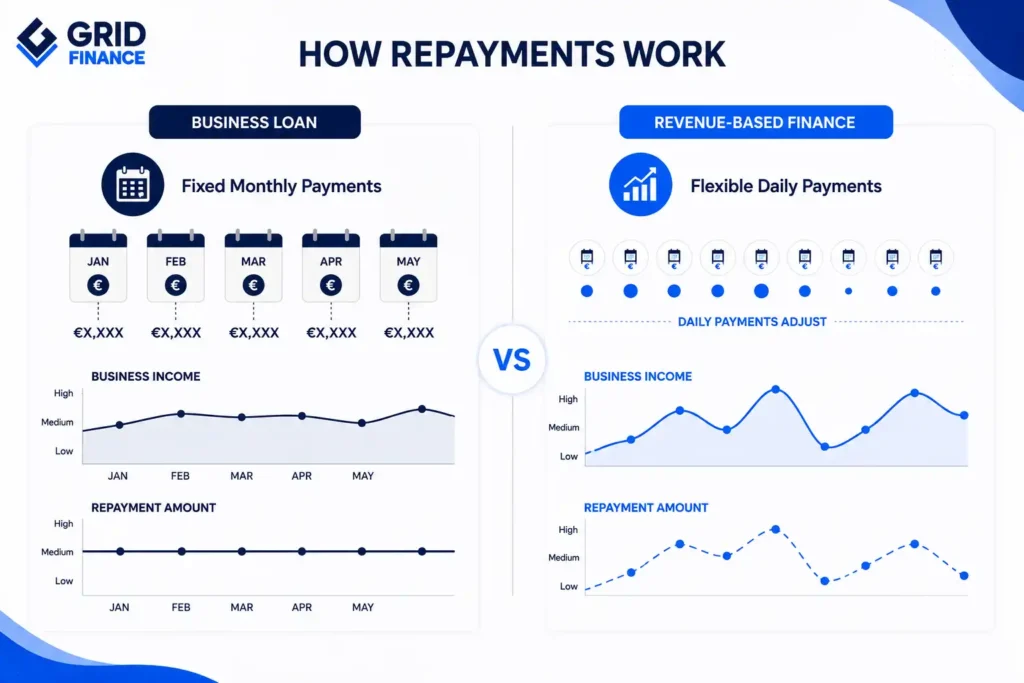
A business loan works on a set schedule agreed at the start, typically monthly, calculated against the loan amount, term and interest rate. It’s predictable, which some business owners genuinely prefer, but that predictability comes at the cost of flexibility if trading dips.
When people compare revenue-based finance vs business loan costs, they’re often comparing the wrong thing. Neither option is inherently more expensive. It depends on how your income actually behaves. A business loan’s fixed rate can work out cheaper over a stable, predictable trading period, because you know the total cost from day one. Revenue-based finance charges a fee calculated on the funding drawn rather than a traditional interest rate, so the cost flexes with how much of the facility you’re using.
Picture two businesses each borrowing the same amount. One takes a fixed business loan with the same repayment due every month regardless of trading conditions. The other takes revenue-based finance, with repayments moving in line with the rolling average of income, easing off the week a big client payment runs late. Over a strong, steady quarter, the fixed loan might work out marginally cheaper on paper. Over a shaky one, the revenue-based structure is the only one of the two that adjusts instead of demanding the same amount regardless.
Eligibility is where revenue-based finance vs business loan comparisons get most confusing for Irish business owners. Qualifying for either option generally means being Republic of Ireland registered and trading for at least nine months, which rules out very early-stage businesses either way. Beyond that baseline, a bank loan usually wants a longer trading history and stronger asset backing before it says yes.
Revenue-based finance tends to look more at the consistency of income coming in, rather than the size of the balance sheet. If your business has genuine trading income but hasn’t built up the assets a bank wants to see, GRID’s B2B facility is built around that reality, lending between €10,000 and €500,000 based on trading income rather than a lengthy credit history. It’s worth checking your business credit score beforehand too, so you know where you stand before applying to either type of lender.
Neither option usually needs property as security. A personal guarantee is standard practice across most Irish business funding, revenue-based finance included, and for larger facilities a deed of assignment or debenture can also come into play.
Where they genuinely differ is in the underlying trust mechanism. Revenue-based finance runs on an open banking connection regulated by the Central Bank of Ireland, which you can revoke at any stage, giving the lender visibility on trading income without asking for a charge over property.
A traditional business loan through a bank can take weeks, sometimes longer, once you account for documentation, underwriting and internal approval stages. Revenue-based finance is built to move faster because it’s assessing trading income rather than working through a lengthy credit process.
Credit decisions on GRID’s B2B facility typically come back within 48 hours, with the entire application running online. If timing matters as much as the funding itself, that gap is often the deciding factor.
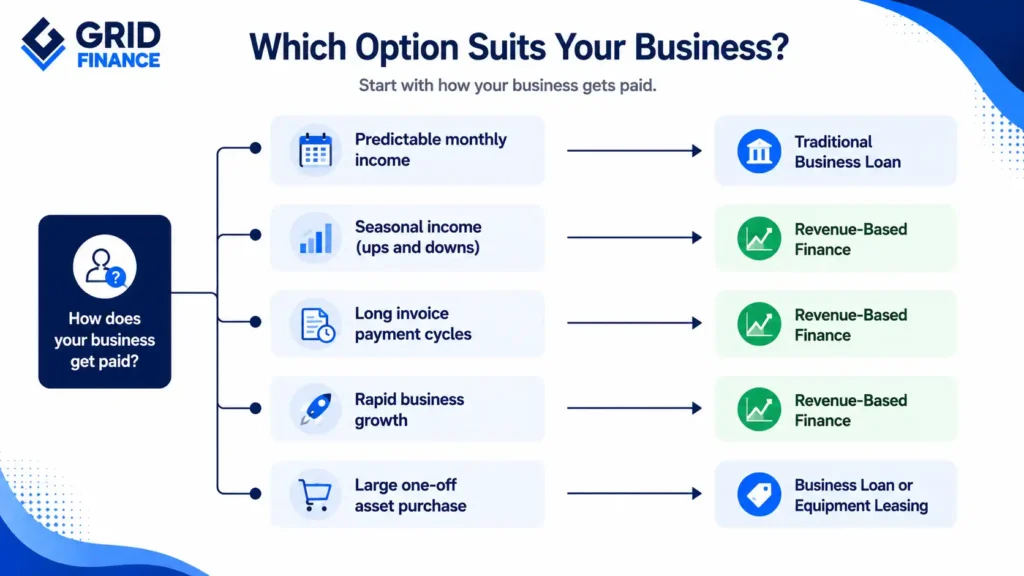
If your income is genuinely irregular, invoicing on long payment terms, working through seasonal peaks and quiet spells, or growing month to month, a fixed repayment schedule works against you more often than it works for you. Revenue-based finance is built specifically for that pattern.
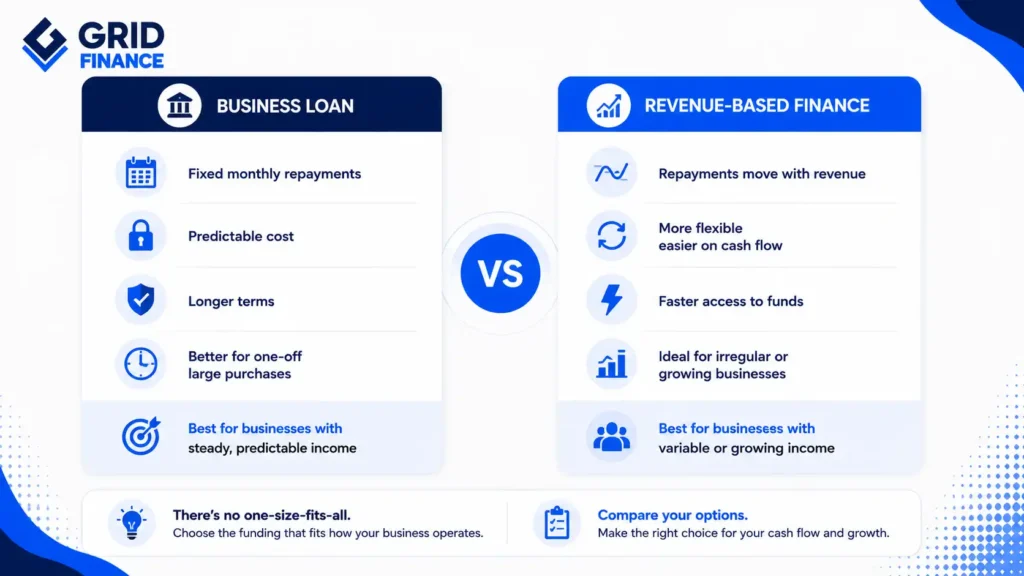
A steadier business with predictable monthly income and a longer trading history might find a fixed-rate loan simpler, and potentially cheaper, over its term. Neither option is universally better. It comes down to how reliably your business gets paid. Comparing your funding options properly before applying is worth the ten minutes it takes.
For a single large purchase like new machinery or a property fit-out, a fixed-term business loan is often the more natural fit, since you know the exact repayment and end date from the outset. Revenue-based finance suits ongoing or recurring cash flow needs better than a one-off capital purchase, though GRID’s leasing option is worth considering separately for equipment specifically, since it’s structured for that exact scenario with no upfront cost.
There’s no universal winner in the revenue-based finance vs business loan debate, only the option that matches how your business actually gets paid. GRID Finance has supported over 4,000 Irish businesses across more than 13 years, funding more than €200 million to Irish SMEs, with B Corp certification and a 92% NPS customer satisfaction rating behind its B2B facility. Whichever way you lean, start from how your income actually behaves, not which product sounds more sophisticated on paper.


Flexible Finance Solutions for Your Clients in Just 48 Hours.
Set up a partner account and start referring clients. Our easy-to-use platform ensures you can apply 24/7 from anywhere.
