In Partnership With:


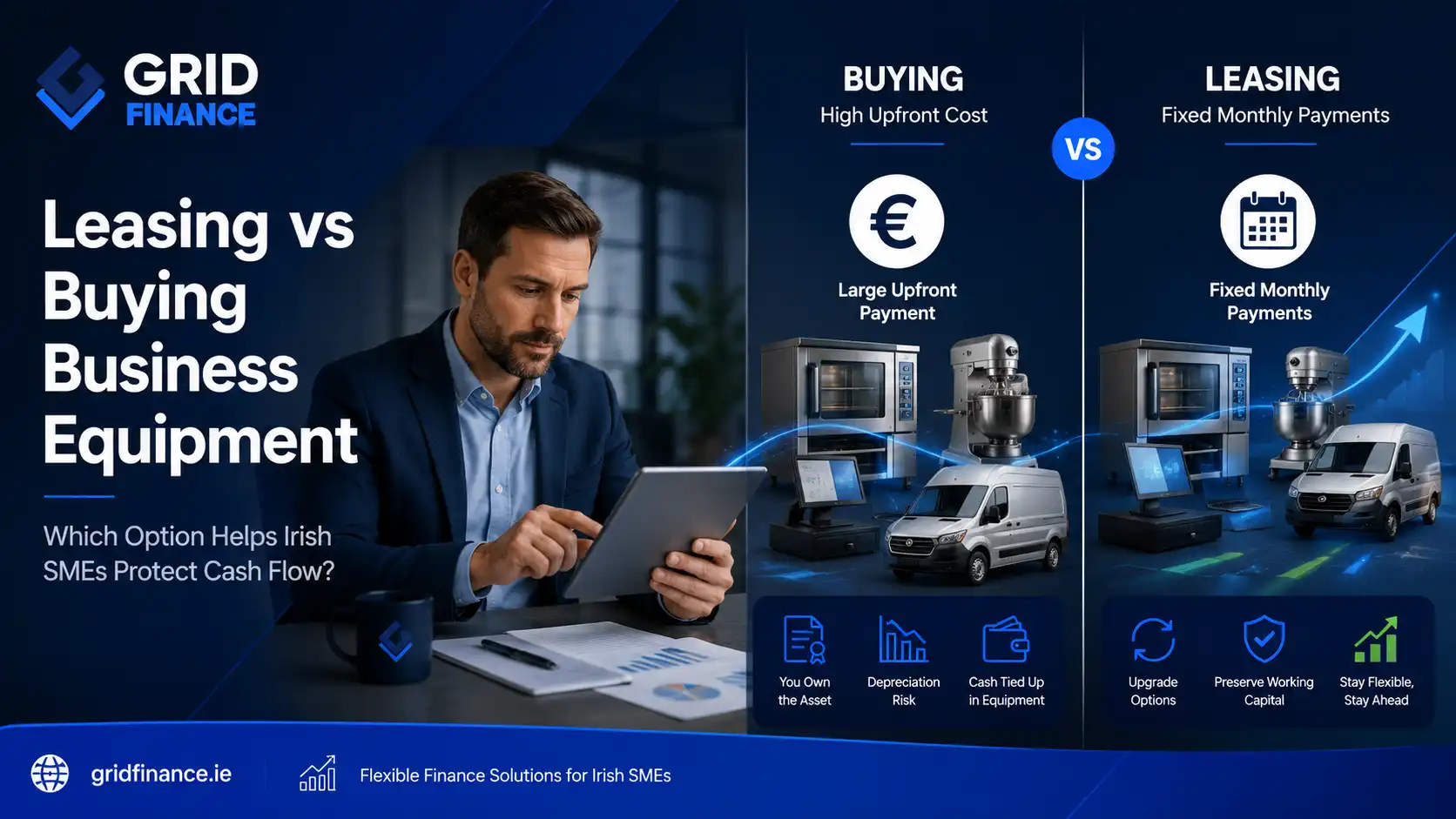
When a piece of kit gives up or your business finally outgrows what you’ve got, you’re faced with a decision that shapes your cash flow for years to come: buy the equipment outright, or lease it. The leasing vs buying business equipment question doesn’t have one right answer. It depends on how your business earns money, how fast the equipment will date, and how much cash you can afford to tie up on day one. This guide walks through both routes properly, so you can make the call with your eyes open.
Buying outright is the simplest option to understand. You pay the full price, the equipment is yours, and there’s no monthly repayment hanging over the business once the invoice is settled. For equipment with a long working life and little risk of going out of date, that simplicity has real appeal.
The catch is the upfront hit. A commercial oven, a fleet of vans, or a full IT refit can run to tens of thousands of euro, and that money comes straight out of your working capital. For an SME, that’s cash that isn’t available for stock, wages, marketing, or covering a slow month. Buying also puts the depreciation risk on you. If the equipment loses value fast, or a newer version makes it obsolete within a couple of years, you’re left holding an asset worth less than what you paid, with no easy way to upgrade.
There is a tax upside to ownership worth knowing about. Revenue allows businesses to claim a wear and tear allowance of 12.5% of the equipment’s cost per year, spread over eight years, against qualifying plant and machinery. That reduces your taxable profit gradually rather than all at once. It’s a genuine benefit, but it plays out slowly, and it doesn’t help with the immediate cash flow squeeze of paying for the equipment in the first place. Your accountant can confirm exactly what qualifies and how it applies to your business.
Leasing flips the equation. Instead of one large payment, you spread the cost of the equipment across fixed monthly instalments, and the cash you’d have spent upfront stays in the business. For a growing SME, that difference alone can be the reason a leasing arrangement makes more sense than buying.
GRID Finance Leasing is built around exactly this problem. Rather than draining your account for a kitchen fit-out or a new IT system, you get 100% financing on the asset, pay a fixed monthly amount, and keep your working capital free for everything else the business needs. Approvals typically come through within 24 hours, so equipment that’s holding your business back doesn’t have to sit on a wish list while you save up.
The other advantage is what happens at the end of the term. With GRID Finance Leasing, you can choose to return the equipment, buy it outright, or upgrade to something newer. That matters more than it sounds, because it means you’re not stuck with outdated kit just because you own it. For anything that changes quickly, POS systems, laptops, commercial kitchen technology, that flexibility can save real money over a few years.
The tax picture for leasing is a bit more nuanced than for buying outright, and it depends on how the lease is structured. Where a lease is structured as a finance lease, with the risks and rewards of owning the asset effectively sitting with your business, you can often still claim capital allowances on it, much like you would if you’d bought it outright. Revenue generally treats lease payments, or the interest element within them, as a deductible business expense too.
The exact treatment depends on the type of lease and how your business is structured, so it’s worth running your specific numbers past your accountant before you sign anything. Getting that detail right can shift the real cost comparison between leasing and buying more than people expect.
Strip away the spreadsheets and most Irish SMEs end up making this call on cash flow alone. Buying ties up a lump sum that could otherwise go into stock, staff, or simply covering you through a quiet month. Leasing keeps that capital free and turns an unpredictable expense into a fixed monthly cost you can plan around.
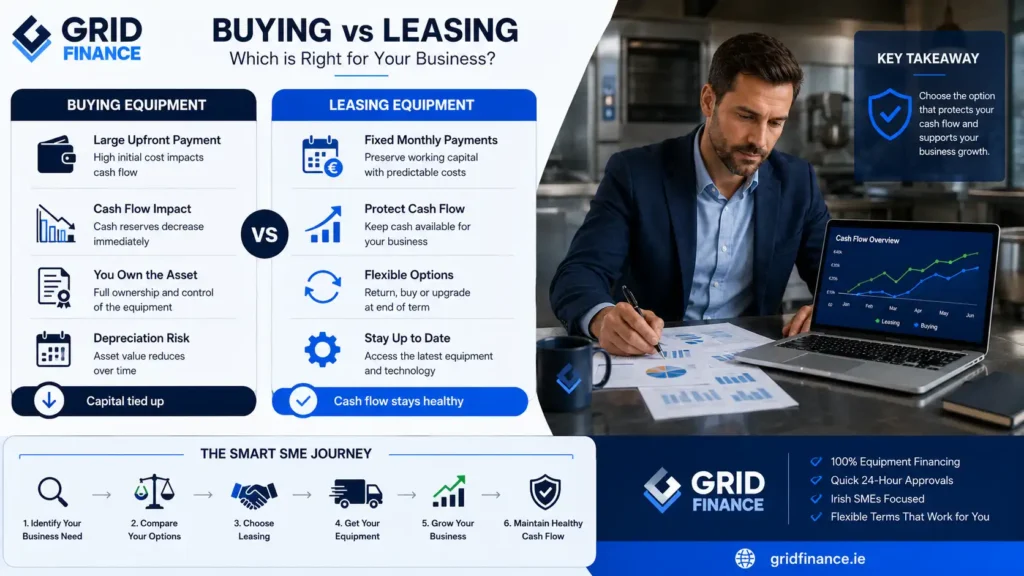
That’s also why leasing tends to suit businesses with fluctuating income better than a straight purchase does. If your revenue moves with the seasons or with footfall, a predictable monthly repayment is a lot easier to manage than a large one-off outlay. GRID Finance’s flexible finance options work on a similar principle for working capital more broadly, matching repayments to how your business actually trades rather than forcing a rigid schedule onto an irregular income.
Buying tends to win out when the equipment has a long useful life and won’t date quickly. Heavy machinery, fixtures, and fittings that will still be doing the job in ten years often cost less over their lifetime if you buy them outright, provided you have the cash reserves to cover it without straining the business elsewhere.
If you’re confident the equipment won’t need replacing for a long time and you won’t need that capital for anything else, ownership can be the cheaper route in the long run.
Leasing tends to win when the equipment changes fast, when cash flow is tight, or when your business is still finding its feet and needs capital free for growth. Technology, POS systems, and hospitality kitchen equipment all fall into this category. So does any situation where preserving cash for stock, staff, or marketing matters more than owning the asset outright.
Ask yourself three questions before you commit either way. How long will you realistically use this equipment before it needs replacing? Can your business absorb the upfront cost without straining cash flow elsewhere? And does owning the asset outright actually matter to you, or is access to the equipment the real goal?
If the answers point towards preserving cash and staying flexible, leasing is usually the better fit. If they point towards a long-life asset and a business with cash to spare, buying can work out cheaper. Either way, it’s worth running the actual numbers for your business rather than going with instinct. If leasing looks like the right direction, GRID Finance Leasing is built specifically for Irish SMEs facing this exact decision.


Flexible Finance Solutions for Your Clients in Just 48 Hours.
Set up a partner account and start referring clients. Our easy-to-use platform ensures you can apply 24/7 from anywhere.
