In Partnership With:


You’ve done the work, sent the invoice, and now you wait. Thirty days is standard in Ireland. Sixty isn’t unusual. Ninety happens more often than most business owners would like. Meanwhile, wages, suppliers and rent don’t wait for anyone.
That gap between doing the work and getting paid for it is one of the oldest problems in business, and invoice finance exists specifically to close it. If you’re looking into invoice finance in Ireland, you’re probably trying to answer something fairly practical: can unpaid invoices become cash now, instead of in six or eight weeks? The answer is yes, and there’s more than one way to structure it.
Invoice finance lets a business release cash tied up in unpaid invoices rather than waiting 30, 60 or 90 days for a customer to pay. A finance provider advances a percentage of the invoice’s value upfront, then pays the balance, minus fees, once the customer settles. It comes in two main forms: factoring and discounting.
Instead of a single loan against your company’s assets, invoice finance treats each invoice, or your whole sales ledger, as the security. The more you invoice, the more funding capacity you typically have, which is part of why it appeals to B2B firms with long payment terms built into every contract.
In practice, you keep invoicing your customers exactly as you always have. Nothing changes on their side, at least not immediately. You send the finance provider a copy of the invoice, or your whole sales ledger, and they release an agreed percentage of its value, typically 80% to 90%, often within a day or two.
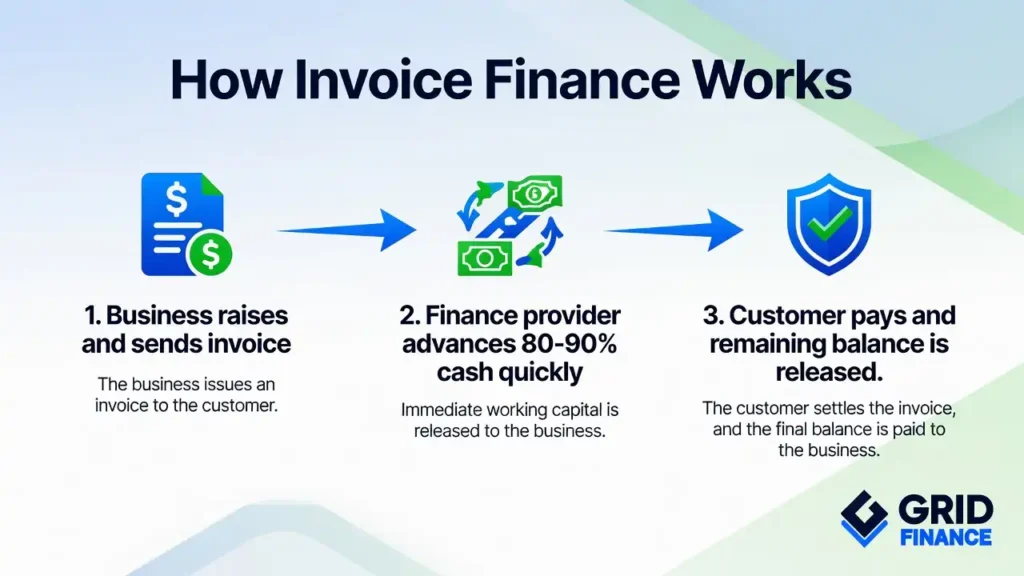
Your customer eventually pays what they owe, either to you directly or to the finance provider, depending on the arrangement. Once that payment lands, the provider releases the remaining balance to you, minus their fee. Do that across your whole invoice book and you’ve turned a wait of 30 or 60 days into cash within the same week.
This is where most people researching invoice finance get a little lost, so it’s worth being direct: factoring and discounting solve the same problem in different ways.
With factoring, you sell your invoices to the finance provider outright. They take over chasing payment and running credit control, which suits businesses that would rather hand that admin off entirely. The catch is that it’s usually disclosed. Your customers know a third party is involved, because that third party is the one calling them for payment.
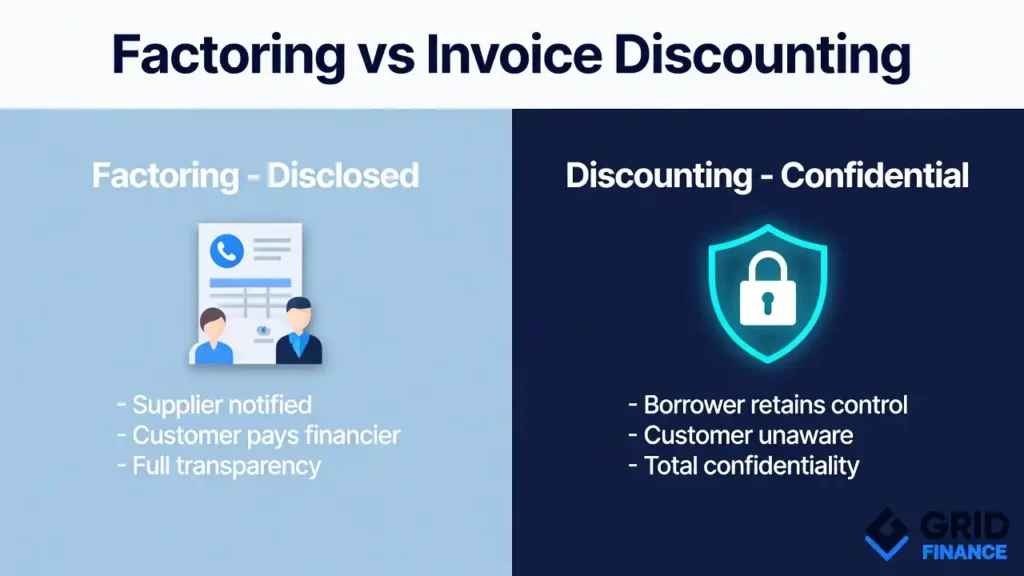
Discounting works differently. You keep ownership of your invoices and keep managing your own credit control, so your customers often never know the arrangement exists at all. That confidentiality is the main reason larger, more established businesses tend to favour discounting, while factoring shows up more often among smaller companies that want the collections work taken off their plate.
Most invoice finance providers advance somewhere between 80% and 90% of an invoice’s value upfront and release the rest once the customer pays. A business with €50,000 in outstanding invoices might see roughly €40,000 to €45,000 land within a day or two of raising the finance request, with the balance following once the customer settles.
The real ceiling isn’t a fixed figure so much as the size of your ledger. Facilities generally grow alongside your sales, so a business invoicing more each month usually sees its available funding grow with it, without renegotiating the whole arrangement from scratch.
This is usually where things get tricky. Traditional invoice finance tends to suit businesses with an established sales ledger, a track record of customers paying reliably, and often a minimum turnover the provider is comfortable with. If your credit control process is patchy, or you’re still building a trading history, qualifying can be harder than the marketing suggests.
That’s not a reason to rule it out, but it’s worth going in with realistic expectations. Newer B2B companies often find they need to weigh up what else is available before committing to a facility that expects more infrastructure than they currently have. We’ll come back to that shortly.
Sometimes, and it depends entirely on which type you choose. Factoring is generally disclosed, so your customers will know a finance provider is managing collections, and plenty of business owners worry about how that looks. Discounting, by contrast, is usually confidential, so nothing changes from the customer’s side at all.
If how your business is perceived by its customers matters to you, that distinction deserves more attention than the headline advance rate does.
Costs generally come in two parts: a discount or service charge, similar in principle to an interest rate, calculated on the funds you’ve drawn down, and a separate fee for collections or administration if you’ve gone with factoring. Exact rates vary by provider, sector, and how reliably your customers pay, so it’s worth getting a clear like for like quote rather than comparing headline percentages alone.
Because the ongoing charge tracks how much of the facility you’re actually using, costs flex up or down with how busy you are, unlike a fixed monthly loan repayment that doesn’t care whether business is quiet or booming.
For some Irish B2B businesses, traditional invoice finance is exactly the right tool. For others, particularly those without the sales ledger infrastructure a factor or discounter expects, a facility based on overall revenue can close the same cash flow gap in a simpler way.

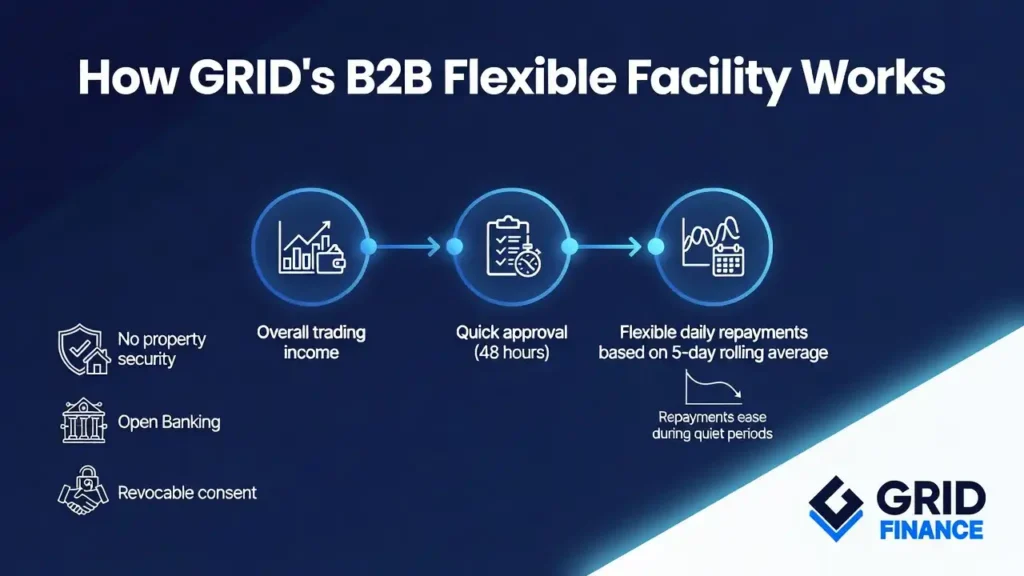
GRID’s flexible finance for B2B businesses lends between €10,000 and €500,000 based on your overall trading income, not against specific invoices. Credit decisions typically come back within 48 hours. Repayments are a small daily amount, calculated from a rolling average of what’s actually coming into your account over five days, so they ease off in quieter periods instead of staying fixed. GRID doesn’t ask for property as security. It takes a personal guarantee instead, along with a deed of assignment or debenture on larger facilities, and the application runs on an open banking connection regulated by the Central Bank of Ireland, which you can revoke at any stage.
It isn’t the same product as invoice finance, and it isn’t trying to be. There’s no selling or assigning individual invoices, and no separate collections arrangement with your customers. What it shares with invoice finance is the underlying purpose: closing the gap between invoicing and getting paid. If you’re weighing this against a traditional facility, find out which funding option suits your business is a reasonable next step, and checking your business credit score beforehand gives you a clearer picture before applying. GRID has also written more on how this revenue based repayment structure works in practice.
Whichever route fits your business, the underlying decision is the same: how much of your future cash flow are you willing to trade for certainty today, and does the structure match how you actually get paid? GRID Finance has supported over 4,000 Irish businesses across more than 13 years, funding more than €200 million to Irish SMEs, with B Corp certification and a 92% NPS customer satisfaction rating, a reasonable starting point either way. GRID’s FAQ page covers most of what comes up before applying.


Flexible Finance Solutions for Your Clients in Just 48 Hours.
Set up a partner account and start referring clients. Our easy-to-use platform ensures you can apply 24/7 from anywhere.
